
Is Your Judgment Migrating? (The Quiet Leadership Crisis)
Feb 02, 2026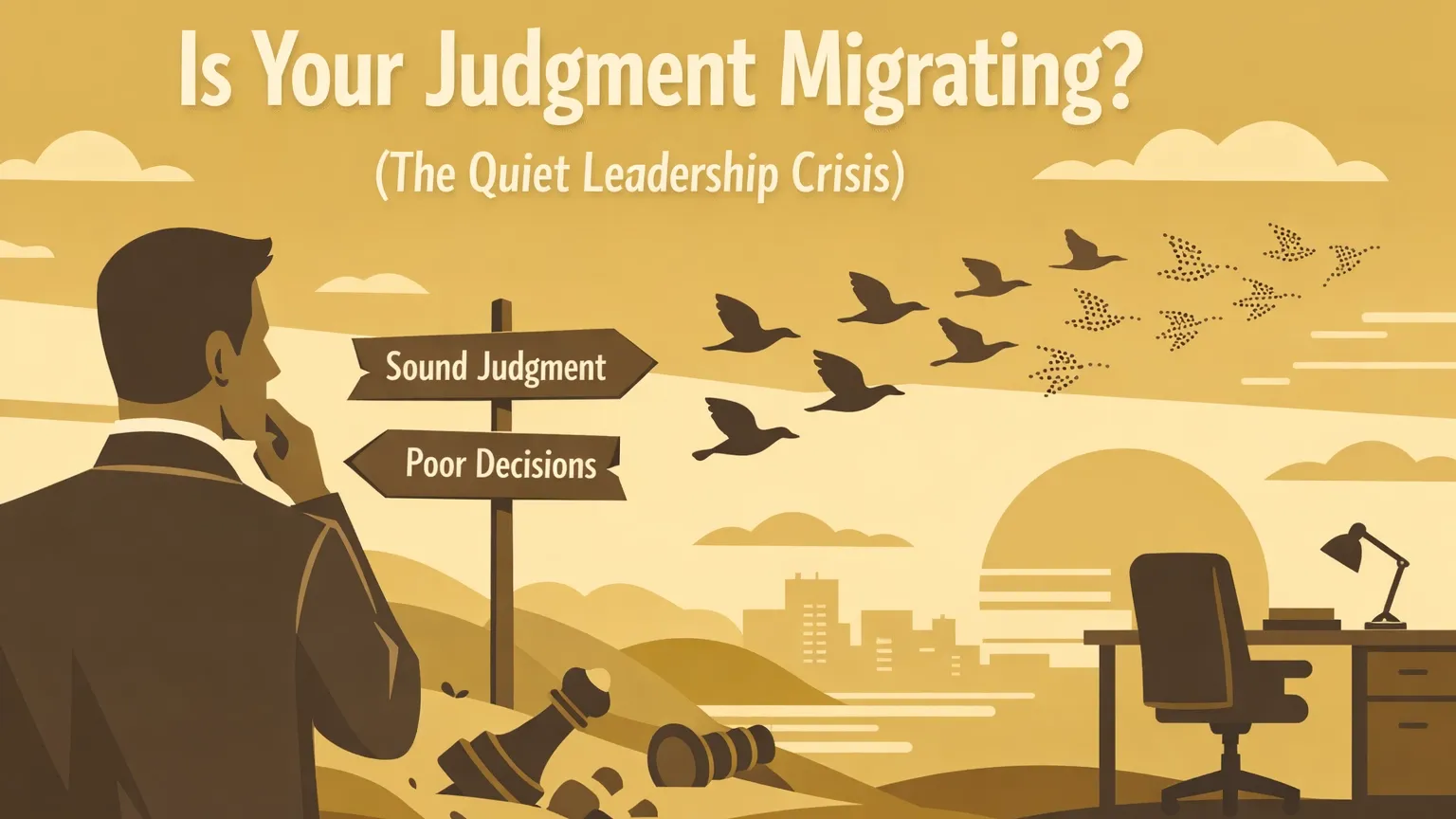
This is Part 1 of "The Ungoverned Judgment Series"
Something feels different.
You can't quite put your finger on it. The dashboards look fine. The forecasts are rolling in faster than ever. Your team is producing outputs at a pace that would have seemed impossible three years ago.
And yet.
There's this nagging feeling. Decisions are moving faster than you can explain them. Approvals happen smoothly, but accountability feels heavier. Recommendations land on your desk looking polished and confident, but when you try to dig into the assumptions underneath? It's like grabbing smoke.
If that resonates, we need to talk.
Because what you're sensing isn't a technology glitch. It's not a process breakdown. It's something far more significant, and far more quiet.
Your judgment is migrating. And it's happening whether you've named it or not.
The Symptoms No One Talks About
Here's what we're hearing from sales leaders across the board:
- Forecasts arrive faster, but fewer people can explain why they changed
- AI-generated recommendations feel authoritative, but they're difficult to verify
- Overriding a recommendation feels politically risky instead of structurally normal
- Decisions get approved, but the judgment path is hard to reconstruct afterward
- Confidence in outcomes has not kept pace with speed
Sound familiar?
These aren't signs that something is broken. That's what makes this tricky.
Everything still works. The machine keeps humming. Reports get filed. Deals close. Quotas get hit, sometimes.
But underneath the surface, something fundamental has shifted. The where and how of decision-making has quietly reorganized itself. And most leadership teams haven't caught up yet.

What "Judgment Migration" Actually Means
Let's get specific here, because this isn't abstract theory. This is about how your organization actually operates.
Every time an AI system summarizes information, ranks options, scores a lead, or recommends a course of action, it shapes the terrain on which human judgment operates.
It decides:
- What information gets noticed first
- Which options feel reasonable
- How quickly a decision moves past review
You still approve outcomes. Your name is still on the final call. But increasingly, those outcomes are shaped by logic you didn't design and assumptions you never discussed.
That's not a loss of authority in the traditional sense.
It's a loss of visibility.
And here's the thing we need to acknowledge: visibility is the foundation of leadership. Without it, you're not leading, you're ratifying.
The Trust vs. Verification Problem
AI creates confidence quickly. Outputs are fast, consistent, and statistically framed. Over time, that consistency starts to feel like reliability. And reliability starts to feel like trust.
But here's where sales leadership coaching gets real: leadership does not operate on trust alone.
It operates on verification.
Trust is psychological. It's the feeling that things are working.
Verification is structural. It's the ability to prove why things are working, and to course-correct when they're not.
When we trust outputs we cannot verify, inputs, assumptions, escalation paths, judgment has already moved outside our control. We're still accountable, but we've lost the ability to explain.
That's a dangerous place to be.

The Statistic That Should Keep You Up at Night
Here's a number that landed hard when we first saw it:
67% of executives say they are ultimately accountable for AI-influenced decisions they do not fully understand.
That's from Deloitte. And it's not a fringe finding, it's the majority.
Think about that for a second. More than two-thirds of leaders are signing off on decisions where they can't fully trace the judgment path. They're accountable for outcomes shaped by systems they didn't design, using logic they can't interrogate.
That gap, between accountability and explainability, is exactly where governance fails.
And in sales organizations? Where forecasts drive resource allocation, where pipeline assumptions shape hiring decisions, where AI-scored leads determine who gets attention? That gap isn't theoretical.
It's operational. It's legal. It's reputational.
This Isn't a Technology Problem
Here's what separates the leaders who navigate this well from the ones who get caught flat-footed:
They recognize this as a leadership issue, not a technology issue.
Technology problems are loud. They throw errors. They break things visibly.
Leadership problems are quiet. They work, until they don't.
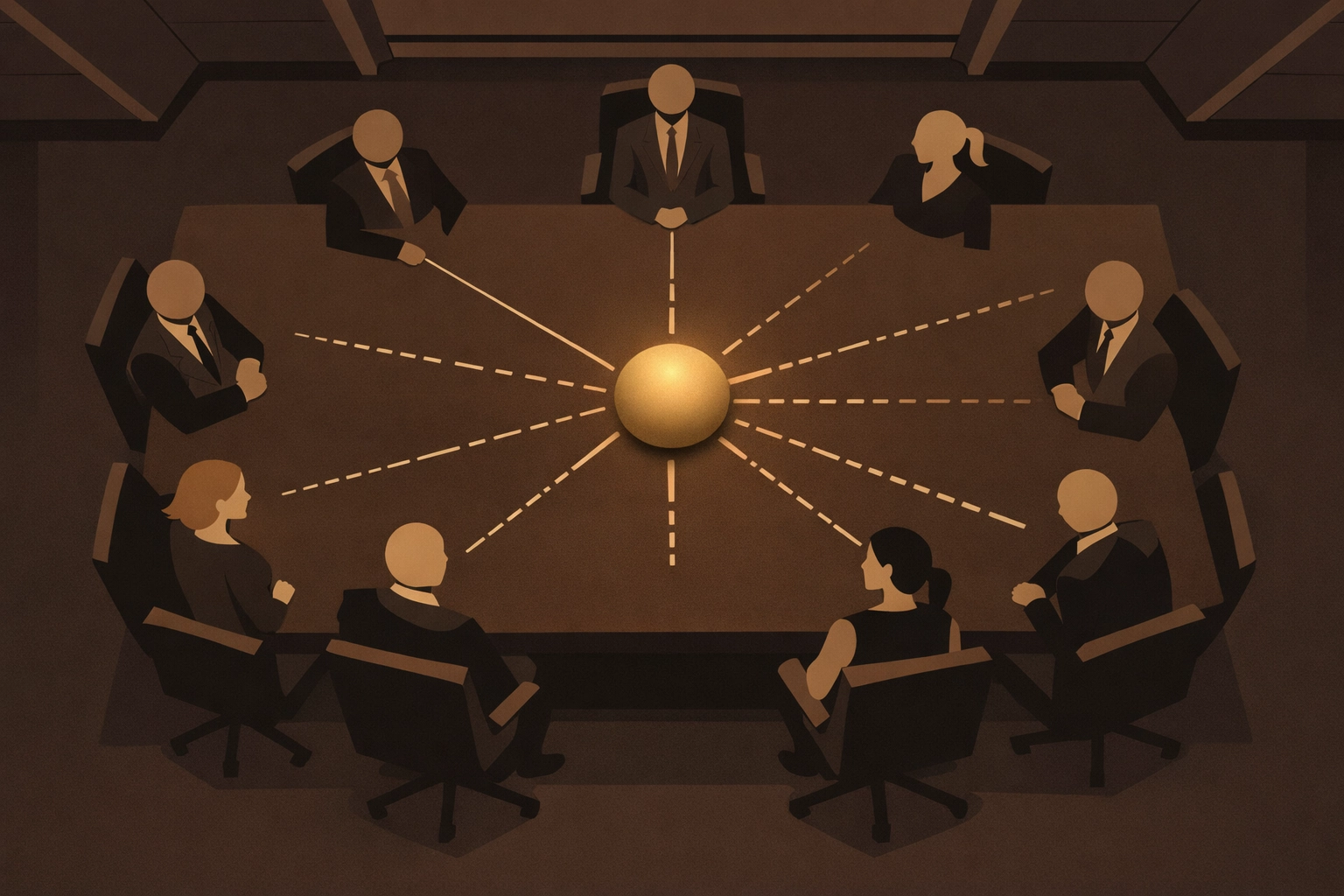
AI accelerates whatever leadership system already exists. When priorities are clear, AI sharpens them. When authority is implicit, AI fills the gaps with probabilistic answers that feel authoritative.
This is why we see the same three symptoms across industries:
- Faster execution with weaker confidence
- More activity with less alignment
- Decisions that are harder to explain after the fact
These aren't failures of intelligence or intent. They're the predictable result of allowing optimization to outrun governance.
What Decision Integrity Actually Looks Like
So what do we do about it?
The answer isn't to slow everything down or reject AI tools. That ship has sailed: and frankly, the benefits are real.
The answer is to rebuild decision integrity deliberately.
Decision integrity means you can trace the judgment path. It means assumptions are surfaced, not buried. It means overrides are structurally normal, not politically risky. It means accountability and explainability travel together.
High-performing organizations don't try to trust AI more.
They design systems that make judgment verifiable at scale.
That's a fundamentally different approach. And it starts with asking better questions:
- Which decisions truly shape our outcomes?
- What inputs are we allowing to influence those decisions?
- Where does judgment belong: human, assisted, or automated?
- How will correction occur when things go wrong?
These aren't IT questions. They're not compliance questions. They're leadership questions. And they deserve leadership attention.
Where Do You Start?
If you're reading this and recognizing your own organization, here's the honest truth: you don't need more content.
You need clarity on where judgment has already shifted: and a framework for getting it back under intentional governance.
That's exactly why we wrote "AI Is Already Influencing Your Company: A Leadership Paper on Decision Integrity and System Governance."
It's not about AI tools, implementation, or adoption. It's about preserving decision authority, accountability, and system integrity as AI begins to shape how judgment is formed inside your organization.
We dig into:
- Why this is a CEO obligation, not a technology task
- The four pillars of maintaining decision ownership
- Real case studies of what happens when governance lags behind speed
- How to design correction loops that actually work
Download the full paper (PDF) directly here →
This is Part 1 of "The Ungoverned Judgment Series." In Part 2, we'll look at a cautionary tale that cost one company over half a billion dollars: and why the real lesson has nothing to do with algorithms.
The migration has already started in your organization. The only question is whether you'll name it before it names you.
At Cleveland Rain, we help leaders build the decision architecture that lets speed and integrity coexist. If what you're reading here reflects what you're sensing inside your organization, that's not coincidence( it's a signal.)
If AI Is Influencing Your Decisions More Than You Think, Start Here.
Leaders feel the shift before they can articulate it:
faster outputs, cleaner dashboards, weaker explanation.
If that resonates, you’re already in the zone where governance matters more than tooling.
Get the brief. Fix the structure.
Then lead from clarity — not drift.
We hate SPAM. We will never sell your information, for any reason.
